

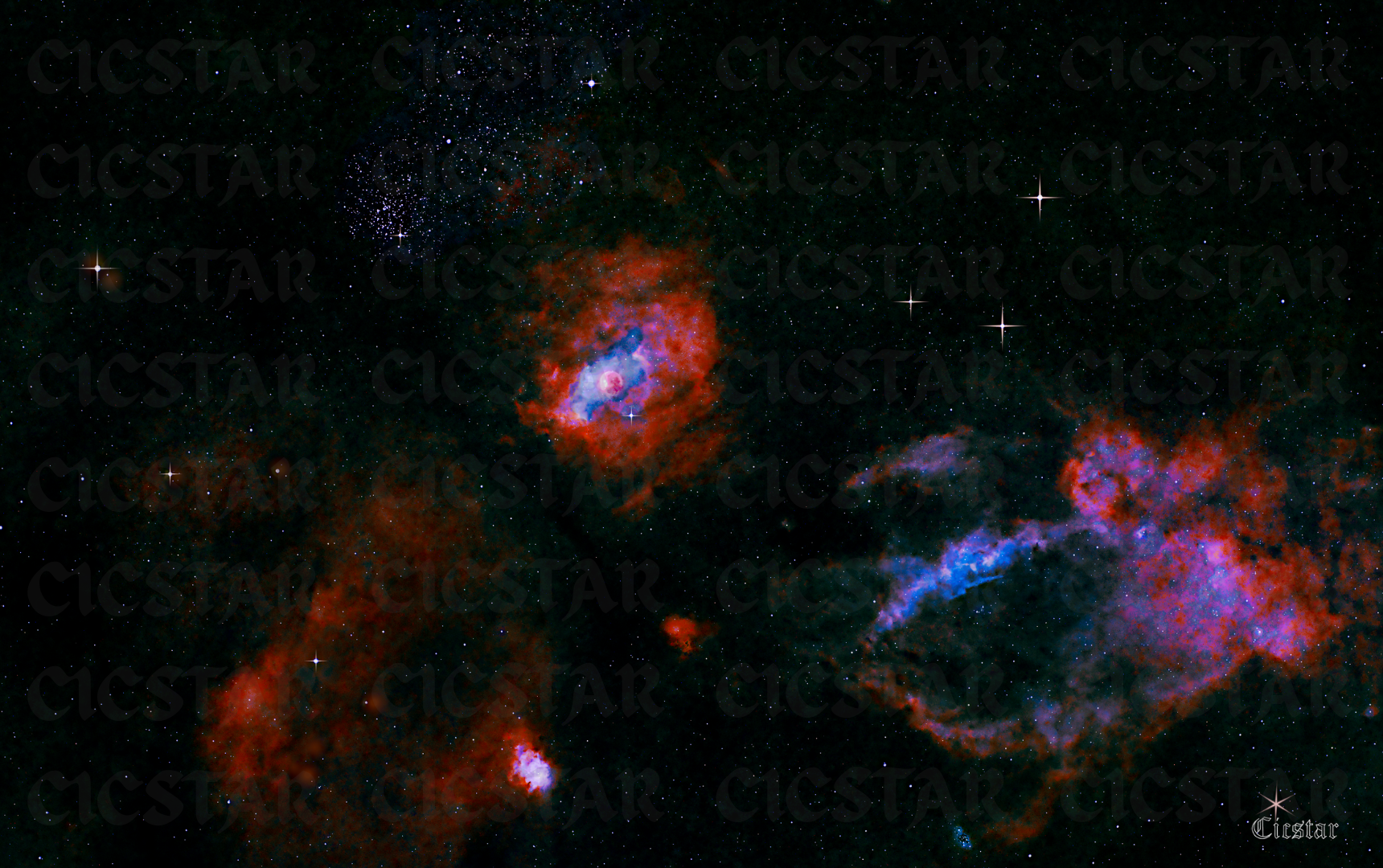
This image reveals a richly detailed region of interstellar gas and dust centered around the Bubble Nebula, a luminous pocket of glowing plasma sculpted by the fierce winds of a massive young star. Located in the constellation Cassiopeia, this region lies roughly 7,100 light-years away and forms part of a sprawling star-forming complex along the Perseus Arm of the Milky Way.
At the heart of the scene, the Bubble Nebula (NGC 7635) emerges as a delicate, nearly spherical shell of blue and rose-tinted ionized gas. The nebula’s distinctive shape is driven by a powerful stellar wind from its central massive star, pushing outward and carving a hollow cavity into the surrounding molecular cloud. Encircling the bubble are dense swaths of red hydrogen emission, where radiation and shock fronts illuminate chaotic tendrils, knots, and curtains of dust.
To the right, larger flowing structures of blue and crimson gas stretch across the frame, part of the broader nebular landscape intertwined with the Bubble Nebula. These clouds reveal regions of ongoing star birth, where radiation from young clusters sculpts the material into luminous ridges and curling filaments. Embedded stars sparkle across the field — some foreground, some newly emerging from the nebula itself — adding depth and dimension to the cosmic tapestry.
The Bubble Nebula region is both serene and violently dynamic: a testament to the ways massive stars shape their environments, forging cavities, shock fronts, and new generations of stars within their glowing, turbulent surroundings.
Constellation: Cassiopeia
Distance: ~7,100 light-years
Type: Emission Nebula / Star-Forming Complex
Catalog Designations: NGC 7635 (Bubble Nebula), Sharpless 162, associated molecular clouds
This image reveals a richly detailed region of interstellar gas and dust centered around the Bubble Nebula, a luminous pocket of glowing plasma sculpted by the fierce winds of a massive young star. Located in the constellation Cassiopeia, this region lies roughly 7,100 light-years away and forms part of a sprawling star-forming complex along the Perseus Arm of the Milky Way.
At the heart of the scene, the Bubble Nebula (NGC 7635) emerges as a delicate, nearly spherical shell of blue and rose-tinted ionized gas. The nebula’s distinctive shape is driven by a powerful stellar wind from its central massive star, pushing outward and carving a hollow cavity into the surrounding molecular cloud. Encircling the bubble are dense swaths of red hydrogen emission, where radiation and shock fronts illuminate chaotic tendrils, knots, and curtains of dust.
To the right, larger flowing structures of blue and crimson gas stretch across the frame, part of the broader nebular landscape intertwined with the Bubble Nebula. These clouds reveal regions of ongoing star birth, where radiation from young clusters sculpts the material into luminous ridges and curling filaments. Embedded stars sparkle across the field — some foreground, some newly emerging from the nebula itself — adding depth and dimension to the cosmic tapestry.
The Bubble Nebula region is both serene and violently dynamic: a testament to the ways massive stars shape their environments, forging cavities, shock fronts, and new generations of stars within their glowing, turbulent surroundings.
Constellation: Cassiopeia
Distance: ~7,100 light-years
Type: Emission Nebula / Star-Forming Complex
Catalog Designations: NGC 7635 (Bubble Nebula), Sharpless 162, associated molecular clouds