

 Image 1 of 1
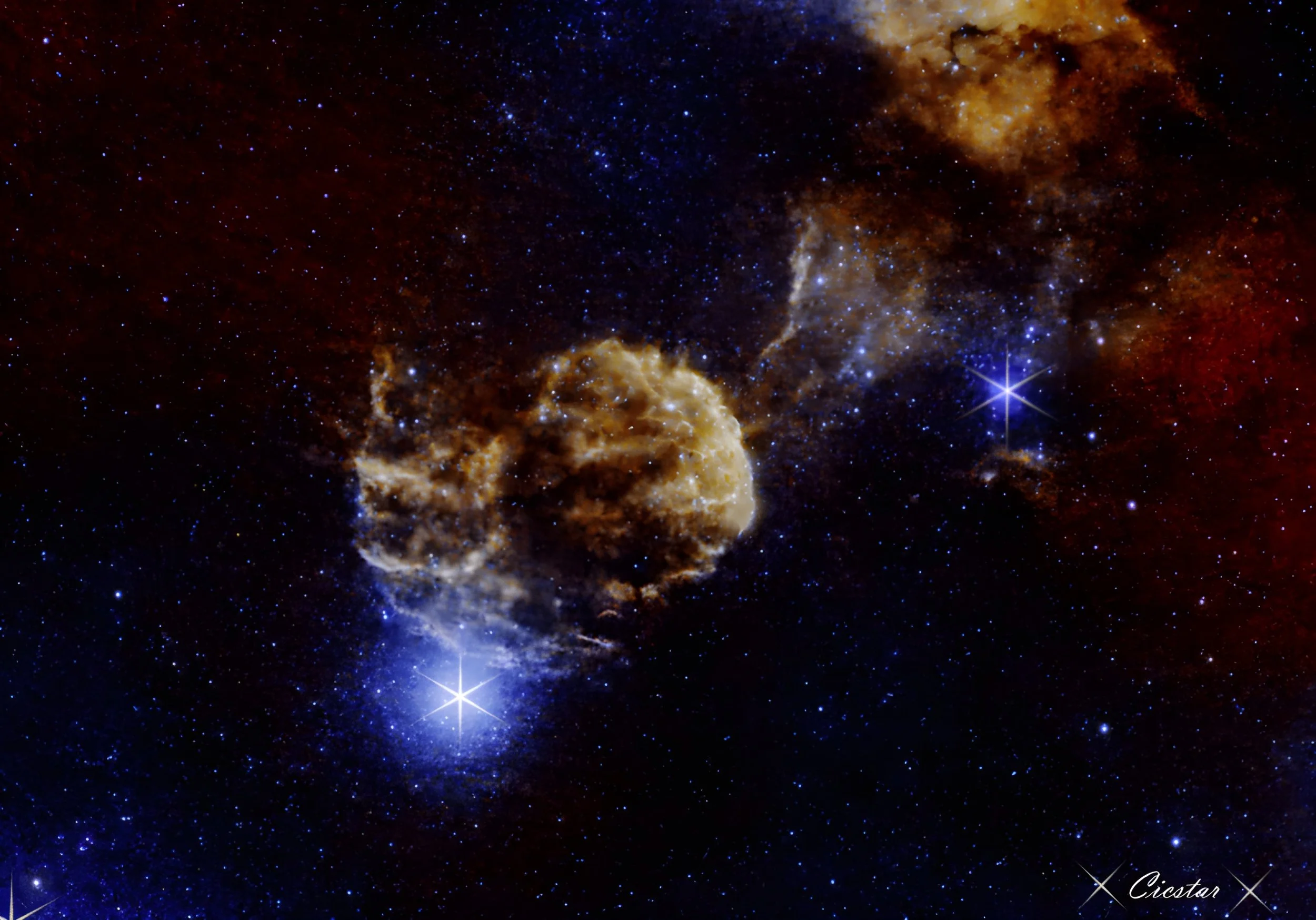
The Jellyfish Nebula (IC 443 / Sharpless 248)
$5.00
The Jellyfish Nebula, cataloged as IC 443, is a sprawling supernova remnant located in the constellation Gemini, roughly 5,000 light-years from Earth. Formed from the explosive death of a massive star, this nebula stretches across space in long, filamentary tendrils that evoke the trailing tentacles of a cosmic jellyfish. As part of a complex region of interstellar gas and molecular clouds, IC 443 is a vivid example of how stellar death seeds the galaxy with new elements and reshapes its surroundings.
In deep images, the Jellyfish Nebula glows in brilliant arcs of red and gold, created by shock-heated hydrogen and sulfur cascading outward from the remnant’s center. The nebula’s delicate filaments weave through the darkness like glowing threads, some curling into intricate knots while others sweep gracefully across the frame. Bands of cooler, bluish emission from oxygen trace the outer edges of the shock front, adding depth and contrast to the structure.
Embedded within the nebula lies a pulsar — the dense, rapidly spinning core of the exploded star — whose energetic winds help sculpt the surrounding gases into the sweeping forms seen today. Surrounding interstellar clouds diffuse the light and produce a mottled background texture, further highlighting the Jellyfish Nebula’s flowing, organic appearance.
The Jellyfish Nebula is both haunting and beautiful — a testament to the transformative power of a supernova, where the end of one star’s life becomes the raw material for the next generation of cosmic structures.
Constellation: Gemini
Distance: ~5,000 light-years
Type: Supernova Remnant
Catalog Designations: IC 443, Sharpless 248, G189.1+3.0