

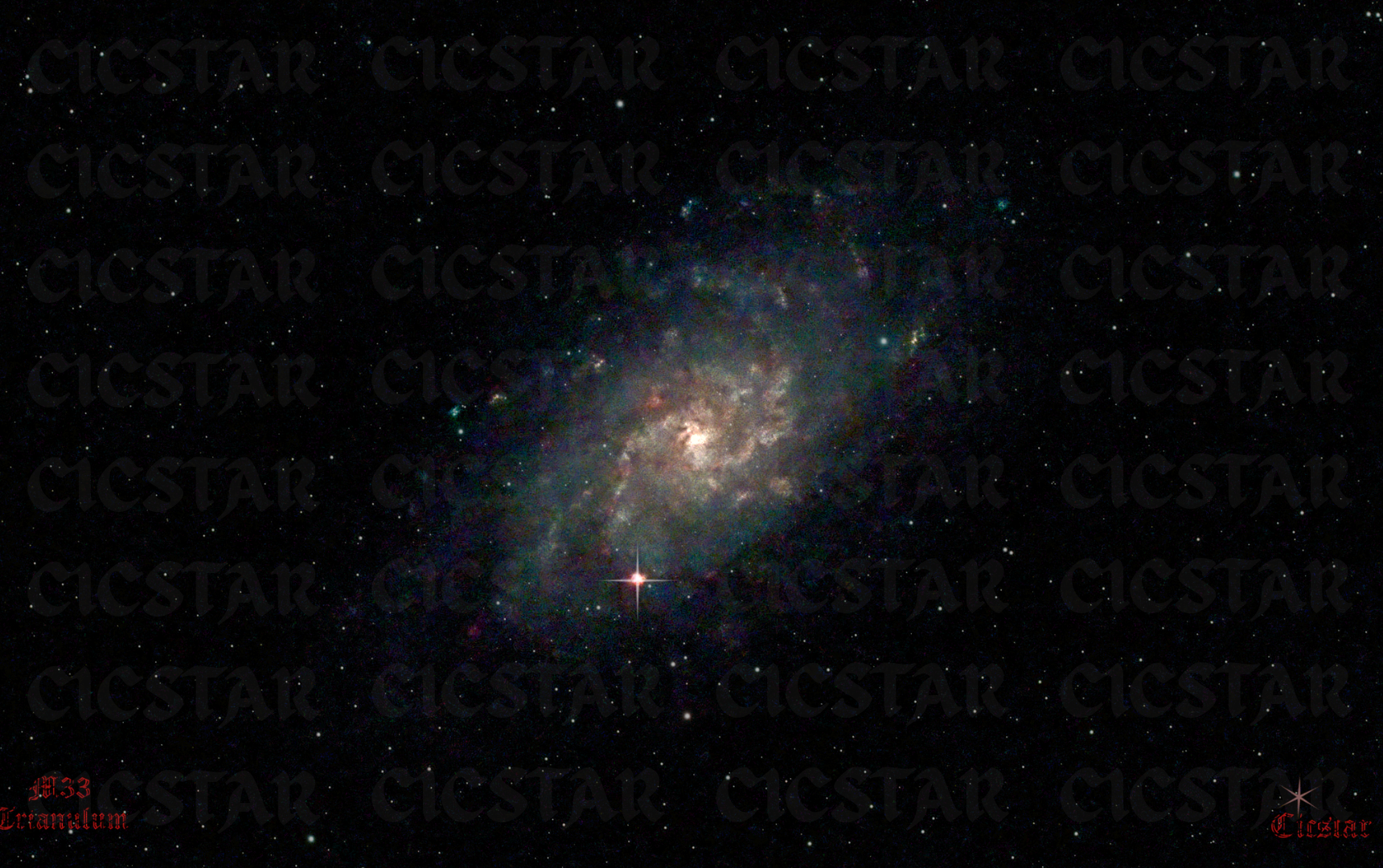
The Triangulum Galaxy, also known as M33, is a sprawling spiral galaxy located in the small northern constellation Triangulum, roughly 2.7 million light-years from Earth. As a prominent member of the Local Group — home to the Milky Way and Andromeda — M33 stands out for its open, delicate spiral structure and its abundance of luminous star-forming regions scattered across its winding arms.
In wide-field images, M33 reveals itself as a graceful pinwheel of soft blues, pinks, and silver-white light. The galaxy’s loosely wound arms are rich with ionized hydrogen clouds, where newborn stars blaze fiercely enough to excite the surrounding gas into glowing patches of crimson and rose. Among these regions, the massive nebula NGC 604 shines brilliantly — one of the largest known star-forming complexes in the Local Group, rivaling even the enormous stellar nurseries found in Andromeda.
The galaxy’s central core glows with a gentle, diffuse brightness, lacking the dense bulge typical of many spirals. Instead, M33’s structure is airy and open, giving it a distinctly delicate appearance. Dust lanes weave softly through the arms, while clusters of young blue stars trace the spiraling pattern that winds outward into the darkness of intergalactic space.
M33 is both elegant and active — a galaxy where star formation thrives, shaping its shimmering arms and adding new chapters to the ongoing story of galactic evolution.
Constellation: Triangulum
Distance: ~2.7 million light-years
Type: Spiral Galaxy (SA(s)cd)
Catalog Designations: M33, NGC 598, Triangulum Galaxy
The Triangulum Galaxy, also known as M33, is a sprawling spiral galaxy located in the small northern constellation Triangulum, roughly 2.7 million light-years from Earth. As a prominent member of the Local Group — home to the Milky Way and Andromeda — M33 stands out for its open, delicate spiral structure and its abundance of luminous star-forming regions scattered across its winding arms.
In wide-field images, M33 reveals itself as a graceful pinwheel of soft blues, pinks, and silver-white light. The galaxy’s loosely wound arms are rich with ionized hydrogen clouds, where newborn stars blaze fiercely enough to excite the surrounding gas into glowing patches of crimson and rose. Among these regions, the massive nebula NGC 604 shines brilliantly — one of the largest known star-forming complexes in the Local Group, rivaling even the enormous stellar nurseries found in Andromeda.
The galaxy’s central core glows with a gentle, diffuse brightness, lacking the dense bulge typical of many spirals. Instead, M33’s structure is airy and open, giving it a distinctly delicate appearance. Dust lanes weave softly through the arms, while clusters of young blue stars trace the spiraling pattern that winds outward into the darkness of intergalactic space.
M33 is both elegant and active — a galaxy where star formation thrives, shaping its shimmering arms and adding new chapters to the ongoing story of galactic evolution.
Constellation: Triangulum
Distance: ~2.7 million light-years
Type: Spiral Galaxy (SA(s)cd)
Catalog Designations: M33, NGC 598, Triangulum Galaxy